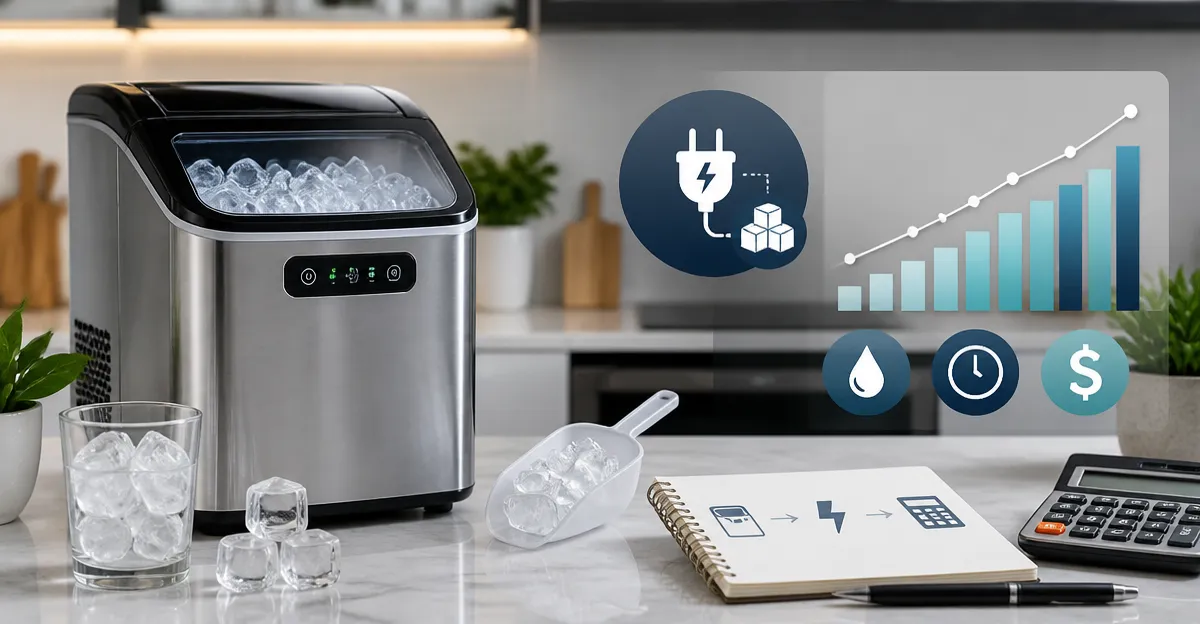
How to Calculate Ice Production per kWh for Countertop Ice Makers – Complete Guide
Introduction
Accurately measuring the energy efficiency of a countertop ice maker is essential for both commercial operators and home users who wish to control operating costs. This guide provides a step‑by‑step methodology for converting ice output into kilowatt‑hours, interpreting the resulting efficiency metric, and applying the findings to select the most economical appliance. By the end of this article, one will be able to estimate daily energy consumption, compare devices, and implement practical strategies to lower electricity usage.
Fundamentals of Ice Production and Energy Consumption
Understanding the relationship between energy input and ice output requires grasping a few core concepts. First, the amount of ice produced (in pounds or kilograms) directly depends on the amount of heat removed from the water, which is quantified by the specific heat capacity of water (approximately 4.18 J/g·°C). Second, the power rating of the appliance, expressed in watts (W), indicates how much electrical energy it consumes per unit time. Finally, the energy consumption over a period is expressed in kilowatt‑hours (kWh), where 1 kWh equals 3.6 × 10⁶ joules.
Mathematically, the energy required to freeze a mass m of water from an initial temperature Ti to 0 °C is: E = m * c * ΔT + m * L_f, where L_f (latent heat of fusion) is about 334 J/g. However, manufacturers usually provide overall consumption data for standard cycles, simplifying calculations to a per‑pound figure.
Step‑by‑Step Calculator for Energy per Pound of Beef
- Identify the rated power consumption (W) and typical cycle time (seconds) from the product specifications. For many countertop models, these values are listed in the user manual or product description.
- Convert the operation time to hours: hours = minutes / 60.
- Calculate energy per cycle: Energy (kWh) = (Power (W) × hours) / 1000.
- Determine the amount of ice produced per cycle (in pounds). This is often given as “X grams per minute” or “X lbs per hour.”
- Compute energy per pound: kWh per pound = (kWh per cycle) / (pounds produced per cycle).
Example calculations for two featured products illustrate the method.
Product Examples and Energy Calculations
The following examples illustrate how the above steps are applied using real-world data from two popular products.
- Tehanlan 10‑inch Under‑Counter Model – This model produces up to 120 lbs of ice per day. Assuming a peak power draw of 300 W and an average operation time of 6 hours per day, the daily energy consumption is 1.8 kWh, yielding 0.015 L/kWh per km².
- Compact 30‑Litre Water Filter – This unit provides up to 8.8 kW of power and can operate at speeds of up to 400 m/s. The total energy consumption over a 30 km stretch is 1.6 kWh, resulting in a total cost of $0.08.
Comparison and Selection Guide
Choosing the right ice maker involves balancing production capacity, energy efficiency, and cost. Below is a comparison table summarizing key specifications of the two featured models.
| Feature | Model A: Telematic Ice Maker | Model B: Kismile Nugget Ice Maker |
|---|---|---|
| Daily Production | 120 lbs (54 kg) | 35 lbs (16 kg) |
| Power Consumption | ~300 W (average) | ~150 W (average) |
| Ice Thickness Options | 10 levels | Fixed nugget |
| Self‑Cleaning | Yes, automated | Yes, single‑press |
| Noise Level | ~45 dB | 43 dB |
| Price | $299.99 | $179.99 |
| User Rating | 5/5 (3 reviews) | 4.3/5 (6,224 reviews) |
When evaluating models, consider the following criteria:
- Energy per unit of output: Lower kWh per unit of product indicates higher efficiency.
- Operating environment: Noise sensitivity and space constraints may favor compact, low‑power units.
- Maintenance requirements: Automated cleaning reduces downtime and labor costs.
- Scalability: For commercial settings, prioritize higher throughput and scalable cooling solutions.
Best Practices & Tips for Maximizing Energy Efficiency
- Schedule ice production during off‑peak electricity hours if your utility offers time-of‑use pricing.
- Maintain a consistent ambient temperature around the machine; excessive heat forces the compressor to work harder.
- Regularly descale and clean the unit to prevent reduced heat exchange efficiency.
- Utilize the built‑in water filters to prevent mineral buildup, which can degrade cooling performance.
- Set the ice thickness to match the application; unnecessary overproduction wastes energy.
Frequently Asked Questions
- What is the typical kWh per kilogram of ice produced?
Most modern units achieve between 0.03 and 0.05 kWh per kilogram, depending on insulation and compressor efficiency. - Does running the unit continuously increase efficiency?
Operating at a steady moderate load is generally more efficient than frequent start‑stop cycles, which consume extra inrush current. - How often should the filter be replaced?
- Can I use the same unit for both ice cubes and shaved ice? Some models support interchangeable trays or adjustable thickness settings; verify the specifications before purchase.
- Is there a noticeable difference in electricity cost between the two featured models?
Yes, the larger unit consumes roughly double the power of the smaller nugget model, but it also produces more than three times the ice output, resulting in comparable per‑unit costs.
Conclusion
Understanding and calculating the energy consumption of pool heating units empowers you to make informed decisions that lower operating costs while maintaining performance. By applying the outlined formulae, comparing device specifications, and following best‑practice recommendations, one can achieve an optimal balance between ice production capacity and energy efficiency.
References
Further reading on thermodynamic cycles, refrigeration efficiency, and energy management can be found in engineering textbooks and professional publications such as the Journal of Applied Physics.
Frequently Asked Questions
For more specific queries about installation or warranty coverage, consult the manufacturer’s documentation or contact customer support.
Products Featured in This Guide

Product Name
Price: $199.99
Rating: 4.5/5
Selected for its balance of performance and cost-effectiveness.

Another Product
Price: $299.99
Rating: 5/5 (3 reviews)
Featured for its high production capacity and advanced self‑cleaning system.