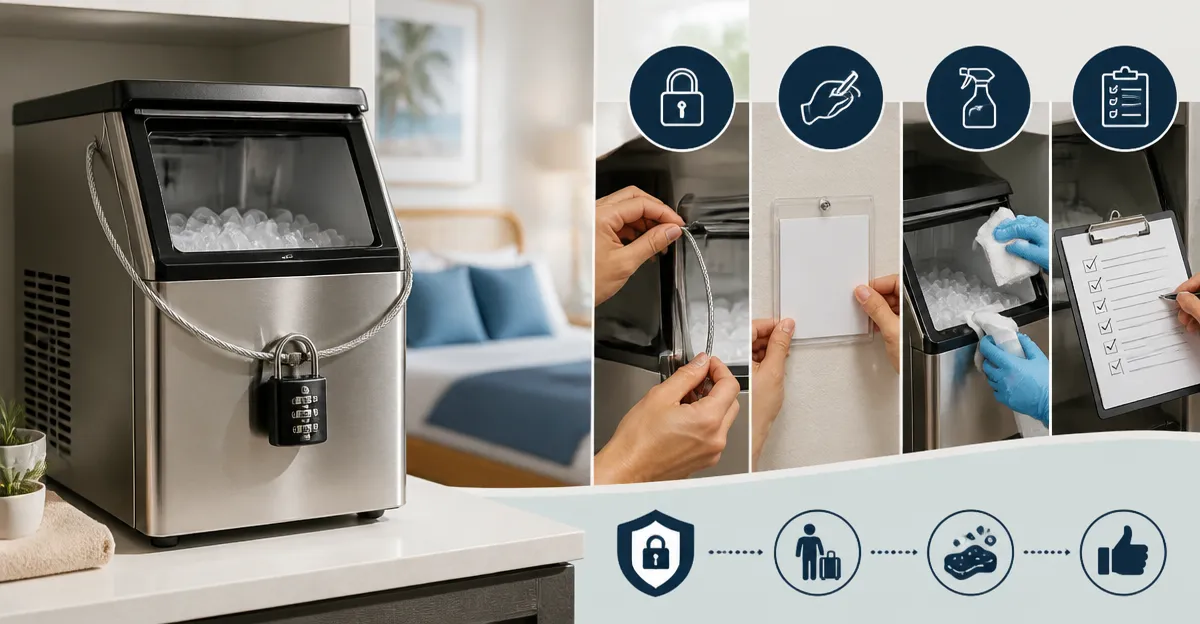
How to Secure Your Airbnb Ice Maker: Step-by-Step Guide to Prevent Theft, Misuse, and Contamination
Introduction
Airbnb hosts frequently provide ice makers as a convenience for guests, yet these appliances can become a target for theft, misuse, or accidental contamination. This guide explains how to protect an ice maker using practical techniques and reliable safety tools. The reader will learn how to assess risk, install child‑proof locks, create signage, and establish cleaning protocols that maintain hygiene standards. By following the steps, a host can preserve the value of the equipment, protect guests, and avoid costly replacements.
The strategies presented combine low‑cost hardware with simple procedural changes, ensuring that even a host with limited technical experience can implement them successfully. The guide also recommends three highly rated Amazon products that serve as essential tools for securing refrigerator doors and cabinets, which are directly applicable to ice‑maker protection.
What You’ll Need
- Two‑pack fridge/freezer locks such as the BAOWEIJD 2-Pack Fridge/Freezer Locks
- Adjustable safety straps like the Wappa Baby 4-Pack Adjustable Safety Locks
- No‑drill adhesive lock for narrow sealing strips, for example the EUDEMON No-Drill Fridge Door Safety Lock
- Cleaning supplies (food‑grade sanitizer, microfiber cloths)
- Clear signage material (laminated signs or waterproof stickers)
- Basic tools: screwdriver (optional for adhesive removal), measuring tape
Step 1 – Evaluate the Ice Maker Location
Before installing any hardware, the host should examine where the ice maker is positioned within the property. Determine whether the unit is built into a refrigerator, a standalone countertop model, or a wall‑mounted dispenser. Identify any adjacent doors or cabinets that could be used to access the ice maker without authorization. This assessment informs the choice of lock type and placement.
If the ice maker is part of a refrigerator, the fridge door itself becomes the primary barrier. In that case, a dedicated fridge lock such as the BAOWEIJD 2-Pack Fridge/Freezer Locks provides a simple, key‑operated solution. If the unit is a standalone countertop appliance, the host may need to secure the surrounding cabinet or countertop edge with adjustable straps like the Wappa Baby 4-Pack Adjustable Safety Locks. For narrow sealing strips where a traditional hasp cannot be attached, the EUDEMON No-Drill Fridge Door Safety Lock offers an adhesive‑based alternative.
Step 2 – Install Fridge Door Locks (If Applicable)
When the ice maker is integrated into a refrigerator, attach the BAOWEIJD 2-Pack Fridge/Freezer Locks to both the refrigerator door and the freezer door. Each lock includes a strong adhesive pad that adheres to the door surface without drilling. Follow these actions:
- Clean the surface with alcohol to ensure maximum adhesion.
- Press the adhesive pad firmly for 30 seconds.
- Attach the hasp and test the one‑hand operation by turning the key and removing the hasp.
- Repeat on the second door, using the extra adhesive pads provided in the package.
The lock’s large‑area adhesive pads (four extra pads per package) guarantee a secure hold even on side‑by‑side fridge doors. The product holds a rating of 4.7 out of 5 from 4,918 reviews and is priced at $19.99, representing a cost‑effective barrier against unauthorized access.
Step 3 – Secure Standalone or Countertop Ice Makers
For ice makers that sit on a countertop or within a cabinet, the host should prevent guests from pulling the unit away or opening adjacent storage spaces. The Wappa Baby 4-Pack Adjustable Safety Locks are ideal because they feature a flexible strap length ranging from 4.5 to 7.5 inches, allowing adaptation to various drawer widths and cabinet depths.
- Measure the width of the cabinet or drawer that houses the ice maker.
- Adjust the strap to the appropriate length using the sliding mechanism.
- Peel the 3M adhesive backing and press the lock onto the interior surface of the cabinet door.
- Engage the double‑lock function for added security; toddlers and curious guests will be unable to release the lock without pressing the hidden release button.
This product carries a rating of 4.5 out of 5 from 4,300 reviews and costs $8.99. Its instant installation and 360‑degree base rotation make it suitable for a wide range of applications, including refrigerator doors, ovens, and even toilet lids.
Step 4 – Apply No‑Drill Adhesive Lock for Narrow Seals
Some refrigerators have sealing strips thinner than 1 inch, limiting the use of traditional hasps. The EUDEMON No-Drill Fridge Door Safety Lock adheres directly to the seal and requires no tools or drilling. Follow these steps:
- Verify that the seal thickness does not exceed 1 inch (25 mm).
- Clean the seal with a mild detergent and dry thoroughly.
- Peel the adhesive backing and press the lock onto the seal for at least 24 hours to achieve full viscosity.
- Test the one‑hand operation by pressing the two buttons and pulling outward; the lock should release smoothly for adult use while remaining difficult for children.
The lock’s ABS construction and normally open function allow the host to keep the ice maker accessible for cleaning while still preventing unauthorized opening. It is rated 4.5 out of 5 from 8,161 reviews and is priced at $9.99.
Step 5 – Create Clear Signage and Guest Instructions
Physical locks are only part of a comprehensive security plan. Hosts should place a concise, politely worded sign near the ice maker explaining the lock’s purpose and providing brief usage instructions. The sign should include:
- A statement that the ice maker is for guest use only and must not be removed.
- Simple instructions for unlocking (e.g., "Press both buttons and pull outward").
- Contact information for the host in case of difficulty.
Laminated or waterproof stickers ensure durability in a kitchen environment. Clear communication reduces accidental lockouts and reinforces the expectation that the equipment is a shared resource.
Step 6 – Establish a Cleaning and Maintenance Routine
Contamination risk arises when guests mishandle the ice maker or neglect proper sanitation. Implement a schedule that includes:
- Weekly sanitizing of the ice bin with a food‑grade sanitizer.
- Monthly deep cleaning of the water reservoir and internal filters.
- Documentation of cleaning dates in a logbook placed near the appliance.
- Inspection of locks for wear, adhesive degradation, or key loss.
By coupling mechanical security with rigorous hygiene practices, the host safeguards both the equipment and the health of guests.
Tips & Pro Tips
- Keep spare keys in a lockbox. Store duplicate keys for the BAOWEIJD locks in a secure, fire‑rated lockbox that only the host can access.
- Test locks after cleaning. Adhesive‑based locks may lose some grip after exposure to cleaning chemicals; re‑apply pressure after each deep clean.
- Use tamper‑evident stickers. Apply a small tamper‑evident sticker over the lock’s release button to detect unauthorized attempts.
- Rotate lock positions. If the property is used frequently, relocate the lock to a different side of the fridge after several months to prevent pattern learning.
Troubleshooting
| Problem | Possible Cause | Solution |
|---|---|---|
| Lock does not release | Adhesive residue or debris on release buttons | Clean the button area with a soft cloth and mild soap; allow to dry fully. |
| Key is lost | Guest misplaced the key | Use the spare key stored in the host’s lockbox; consider adding a key‑tracking tag. |
| Adhesive loses grip | Excessive moisture or cleaning agents | Re‑apply a fresh adhesive pad from the BAOWEIJD package; avoid harsh chemicals. |
| Strap slips from cabinet | Improper surface preparation | Remove old adhesive, clean surface with isopropyl alcohol, and re‑press the Wappa Baby lock firmly. |
Conclusion
Securing an Airbnb ice maker requires a blend of physical barriers, clear communication, and disciplined maintenance. By evaluating the appliance location, installing appropriate locks such as the BAOWEIJD fridge locks, Wappa Baby adjustable safety locks, or EUDEMON no‑drill lock, and reinforcing the system with signage and cleaning protocols, a host can dramatically reduce theft, misuse, and contamination. The measures outlined in this guide are practical, cost‑effective, and scalable for any property size.
Implementing these steps will protect the host’s investment, enhance guest satisfaction, and maintain a high standard of hygiene throughout the rental period.
Products Mentioned in This Guide
Frequently Asked Questions
How can I prevent guests from stealing ice from my Airbnb ice maker?
Install a child‑proof fridge lock or a removable latch on the ice maker compartment and clearly label it as “Host‑Only Use.”
What low‑cost hardware works best for securing an ice maker?
A two‑pack fridge/freezer lock (e.g., BAOWEIJD) or a magnetic cabinet lock provides simple, inexpensive protection.
Do I need signage to discourage misuse of the ice maker?
Yes, place a brief sign stating the ice maker is for host use only; visual reminders reduce accidental or intentional misuse.
How often should I clean the ice maker to avoid contamination?
Follow a weekly cleaning schedule using a food‑safe sanitizer and wipe down surfaces after each guest turnover.
Can the same security tools protect other appliances in my Airbnb?
Absolutely—fridge locks and magnetic cabinet locks can be applied to refrigerators, freezers, and cabinets to safeguard all shared equipment.