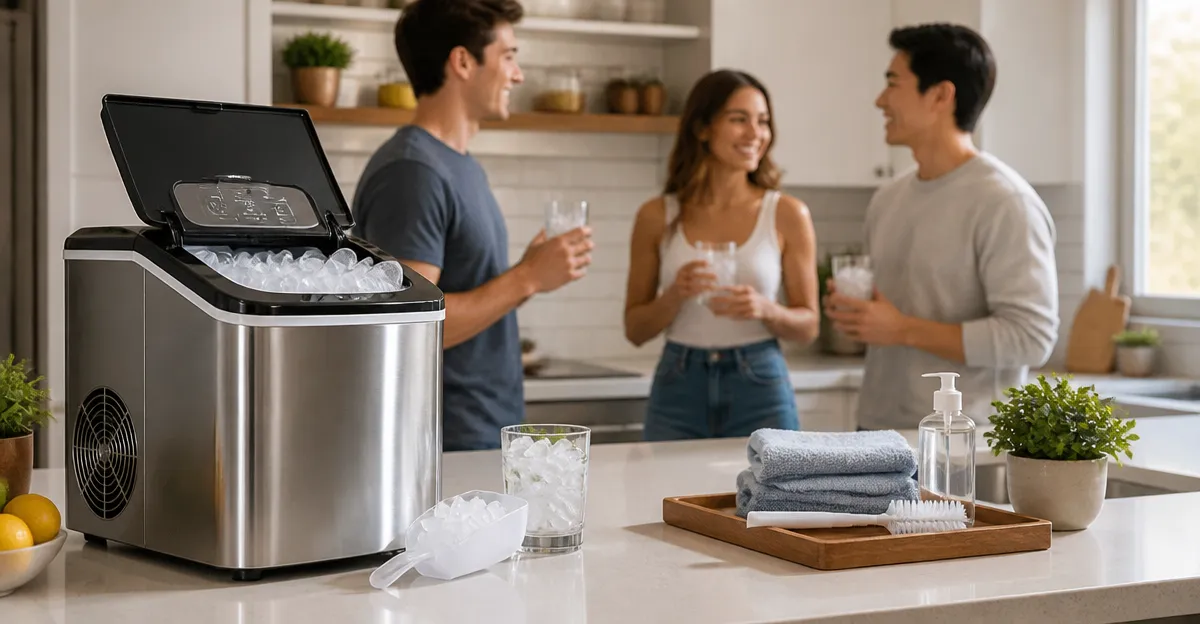
Roommate-Friendly Ice Maker Guide: Smart Tips for Sharing, Cleaning, and Maintaining Your Ice Machine
Introduction
Living with roommates often requires thoughtful negotiation around shared appliances. An ice maker can become a communal asset, providing chilled beverages for study sessions, movie nights, and spontaneous gatherings. This guide explains how to select a suitable model, establish fair usage policies, maintain hygiene, and troubleshoot common issues. Readers will leave with a clear plan for integrating an ice maker into a shared living space without conflict.
Throughout the article, the Antarctic Star Countertop Ice Maker serves as a reference product because it balances capacity, portability, and quiet operation—qualities that matter most in a roommate environment. By the end, one will understand both the technical fundamentals of countertop ice makers and the interpersonal strategies that keep everyone satisfied.
The structure follows a logical progression: background knowledge, detailed sections on selection and usage, a side‑by‑side comparison, best‑practice tips, a concise FAQ, and a final summary. Each section is written in a professional tone, using clear language suitable for an intermediate audience.
Let us begin by establishing the basic principles that underpin countertop ice makers and why they differ from built‑in or commercial units.
Background and Context
Countertop ice makers are compact appliances designed to produce ice quickly without requiring permanent installation. They typically draw water from a reservoir, freeze it into cubes or nuggets, and dispense the ice into a storage bin. The primary advantages include rapid ice production—often eight cubes in under six minutes—and the ability to generate up to 26 lb of ice per day, as seen in many modern models.
Key technical terms frequently appear in product literature. "Capacity" refers to the maximum amount of ice the machine can produce within a 24‑hour period. "Decibel level" measures sound intensity; a rating below 40 dB is considered whisper‑quiet and suitable for shared living spaces where noise can be disruptive. "Self‑cleaning" denotes an automated cycle that melts residual water to prevent odor and bacterial growth.
Understanding these concepts helps roommates evaluate whether an ice maker meets their collective needs. For instance, a high‑capacity unit may be unnecessary for two occupants but essential for a larger household that frequently entertains guests.
Energy consumption also matters. An optimized motor can reduce electricity use by up to 30 %, translating into lower utility bills and a smaller carbon footprint—both attractive attributes for environmentally conscious students.
Choosing the Right Ice Maker for Shared Living
When selecting an ice maker, consider three core criteria: capacity, footprint, and noise level. Capacity should align with the average daily ice demand. A household of two typically requires 5–10 lb per day, while a group of four may approach 15 lb. The Antarctic Star Countertop Ice Maker offers 26 lb/day, providing ample headroom for parties and unexpected guests.
Footprint determines where the appliance can reside. Dimensions of 8.66" × 10.39" × 11.22" allow placement on a kitchen counter, in a dorm kitchenette, or even inside a recreational vehicle. Compactness also facilitates storage during off‑season periods.
Noise level influences roommate harmony. The Antarctic Star model operates at less than 40 dB, comparable to a soft conversation. This quiet performance ensures that study sessions or late‑night conversations remain undisturbed.
Below is a concise decision matrix that helps roommates rank their priorities:
- High Capacity Needed: Choose a model with ≥20 lb/day output.
- Space‑Constrained Kitchen: Prioritize a footprint under 12" × 12".
- Noise Sensitivity: Look for <40 dB operation.
- Energy Efficiency: Seek certifications or claims of ≥30 % energy savings.
By matching these criteria with personal preferences, roommates can agree on a unit that satisfies everyone.
Product Recommendation: Antarctic Star Countertop Ice Maker
The Antarctic Star Countertop Ice Maker exemplifies a well‑rounded choice for shared living spaces. It delivers 26 lb of ice per day, produces eight cubes in six minutes, and operates at a whisper‑quiet <40 dB. Its eco‑conscious motor reduces energy consumption by 30 %, aligning with sustainability goals.
Key features include:
- Eco‑Conscious Performance: Optimized motor and streamlined construction lower electricity use.
- Turbo Ice Production: Rapid cycle produces eight cubes in six minutes.
- Self‑Cleaning Care: One‑touch maintenance cycle eliminates odor and ensures crystal‑clear ice.
- Road‑Trip‑Ready Compactness: Small footprint fits in RVs, dorm rooms, or beach cabanas.
- Library‑Quiet Operation: Noise level under 40 dB supports study environments.
Customer feedback reflects reliability, with a rating of 4.3 out of 5 stars from 3,585 reviews. Priced at $56.48, it offers a cost‑effective solution compared with larger built‑in models that often exceed $200.
Because the product meets the three primary selection criteria—capacity, size, and noise—it is highlighted throughout this guide as the benchmark for roommate‑friendly ice makers.
Comparison and Selection Guide
To aid decision‑making, the table below contrasts the Antarctic Star model with two common alternatives: a budget‑friendly 15 lb/day unit and a premium 30 lb/day built‑in system.
| Feature | Antarctic Star Countertop Ice Maker | Budget 15 lb/day Countertop | Premium Built‑In 30 lb/day |
|---|---|---|---|
| Daily Capacity | 26 lb | 15 lb | 30 lb |
| Dimensions (W × D × H) | 8.66" × 10.39" × 11.22" | 9.5" × 11" × 13" | 24" × 24" × 30" |
| Noise Level | <40 dB | 45 dB | 55 dB |
| Energy Savings | 30 % reduction | 10 % reduction | Standard |
| Price (USD) | $56.48 | $38.99 | $219.99 |
| Customer Rating | 4.3/5 (3,585 reviews) | 4.0/5 (1,210 reviews) | 4.5/5 (850 reviews) |
For most roommate scenarios, the Antarctic Star model strikes the optimal balance between performance and affordability. The budget option may suffice for minimal usage, while the premium built‑in unit is overkill unless the household regularly hosts large gatherings.
Best Practices & Tips for Shared Use
Even the most reliable ice maker benefits from clear household guidelines. The following practices foster fairness, hygiene, and longevity:
- Establish a Usage Schedule: Allocate specific time slots for high‑volume ice production, such as before weekend parties, to prevent simultaneous overload.
- Define Refill Responsibilities: Rotate the duty of refilling the water reservoir weekly; a simple spreadsheet on a shared drive can track assignments.
- Maintain Cleanliness: Activate the self‑cleaning cycle weekly, or after two weeks of inactivity, to avoid stale odors.
- Monitor Ice Consumption: Keep a log of daily ice output; if usage consistently exceeds capacity, consider upgrading to a higher‑output model.
- Respect Noise Hours: Limit ice production to daytime hours if roommates study or sleep early; the quiet operation of the Antarctic Star model minimizes disruption.
In addition to these habits, adopt a few technical tips:
- Use filtered water to reduce mineral buildup and improve taste.
- Place the unit on a stable, level surface to prevent vibration.
- Leave a small clearance around the ventilation openings to ensure proper airflow.
- Periodically inspect the ice basket for cracks; replace if necessary to avoid ice loss.
By integrating these routines, roommates can enjoy consistent ice quality while extending the appliance’s service life.
Frequently Asked Questions
- 1. How often should the self‑cleaning cycle be run?
- For shared environments, a weekly cycle is recommended, especially after periods of heavy use or when the unit sits idle for more than two weeks.
- 2. Can the ice maker be used with bottled or filtered water?
- Yes. Using filtered water reduces mineral deposits and improves ice clarity, which is beneficial for taste and appliance longevity.
- 3. What is the typical noise level during ice production?
- The Antarctic Star Countertop Ice Maker operates at less than 40 dB, comparable to a quiet conversation, making it suitable for study rooms and dorms.
- 4. How much electricity does the unit consume?
- Thanks to its optimized motor, the unit reduces energy consumption by about 30 % compared with standard models, translating to roughly 0.5 kWh per day at full capacity.
- 5. Is the ice maker safe to use in a RV or on a boat?
- Its compact footprint and low power draw make it road‑trip‑ready; however, ensure the power source matches the appliance’s voltage requirements (120 V AC).
- 6. How can roommates split the cost of the appliance?
- Divide the purchase price equally among occupants, or allocate the cost based on usage frequency. A simple spreadsheet can track contributions and reimbursements.
Conclusion
Sharing an ice maker among roommates can enhance hospitality, reduce individual expenses, and simplify beverage preparation. By selecting a model that aligns with capacity, size, and noise considerations—such as the Antarctic Star Countertop Ice Maker—households gain a reliable, energy‑efficient solution.
Establishing clear usage schedules, cleaning routines, and responsibility charts ensures that the appliance remains hygienic and functional for all occupants. Regular maintenance, filtered water usage, and adherence to noise etiquette further promote a harmonious living environment.
Ultimately, the combination of informed product selection and cooperative household practices transforms a simple kitchen gadget into a shared asset that supports social interaction and everyday convenience.
For readers seeking a concrete recommendation, the Antarctic Star Countertop Ice Maker delivers the performance, quiet operation, and eco‑friendly design that most roommate scenarios demand.
Products Featured in This Guide
Antarctic Star Countertop Ice Maker
Price: $56.48
Rating: 4.3/5 (3,585 reviews)
Why featured: Offers 26 lb/day capacity, whisper‑quiet operation, self‑cleaning cycle, and 30 % energy savings—all essential for shared living spaces.