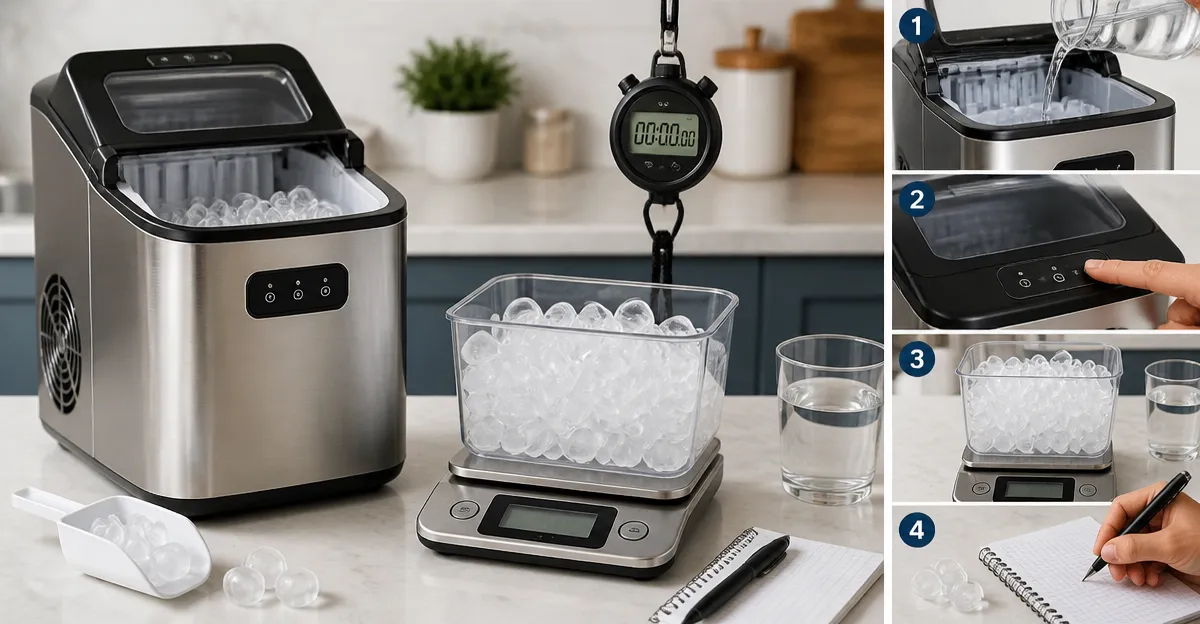
How to Test a Countertop Ice Maker's Production Rate: Step‑by‑Step Guide to Accurately Measure Ice Output
Introduction
One of the most important performance indicators for a countertop ice maker is its production rate. Knowing how many pounds of ice the appliance can generate in a 24‑hour period enables the user to determine whether the unit meets the demands of parties, small gatherings, or daily household use. This guide will teach the reader how to conduct a reliable test, interpret the results, and compare them against manufacturer specifications. By following the procedure, the reader will gain confidence in the appliance’s capabilities and avoid unexpected shortfalls during critical moments.
The methodology described below is grounded in scientific measurement principles while remaining accessible to an intermediate audience. The guide also recommends several Amazon‑available ice makers that serve as practical tools for benchmarking and for users who are still deciding which model to purchase.
What You’ll Need
- A digital kitchen scale capable of measuring at least 30 lb with 0.1 lb precision.
- A clear, graduated container (such as a 2‑liter glass pitcher) to collect ice.
- A stopwatch or smartphone timer.
- Access to clean, cold tap water.
- One of the following countertop ice makers for reference or comparison:
- Paper towels for drying any spills.
Step 1: Prepare the Testing Environment
Begin by selecting a level countertop away from direct sunlight, drafts, or heat sources. The ambient temperature should be stable, ideally between 68 °F and 75 °F, because extreme temperatures can affect the ice maker’s compressor efficiency. Place the digital scale on the countertop and zero it. Then set the graduated container on the scale, ensuring that the combined weight of the container and scale reading is recorded as the baseline.
If the user is testing a new unit, the Antarctic Star Ice Maker is an excellent choice because its eco‑conscious motor reduces energy consumption by 30 %, which can result in more consistent ice output during prolonged testing. The unit is priced at $56.48 and holds a rating of 4.3 / 5 from 3,503 reviews, indicating reliable performance.
Allow the ice maker to run for at least 30 minutes before commencing the measurement to ensure that the internal temperature has stabilized. During this warm‑up period, the user may observe the silent operation; the Antarctic Star model operates at less than 40 dB, making it suitable for quiet testing environments.
Step 2: Fill the Water Reservoir and Start Production
Using clean, cold tap water, fill the ice maker’s reservoir to the recommended level indicated by the manufacturer. For models with a built‑in water tank, such as the Frigidaire Ice Maker, the 2.1 qt tank provides ample capacity for continuous operation without frequent refills. The Frigidaire unit is priced at $— (price not provided) and enjoys a 4.3 / 5 rating from 10,776 reviews, reflecting strong consumer satisfaction.
Press the power button and select the desired ice size. The Frigidaire model offers a digital LED panel that allows the user to toggle between small bullet cubes and larger cubes, facilitating comparison of production rates for each size. Initiate the timer simultaneously with the start of the ice‑making cycle.
It is important to keep the surrounding area clear of obstacles; the ice maker’s condenser needs adequate airflow to maintain optimal cooling efficiency.
Step 3: Collect Ice Over a Fixed Interval
After the first batch of ice is released (typically within 6‑7 minutes for most models), use the included ice scoop from the Frigidaire Ice Maker to transfer the cubes into the graduated container placed on the scale. Record the weight displayed on the scale after each batch. Continue this process for a predetermined interval, such as 60 minutes, to capture a representative sample of production.
The EUHOMY Ice Maker also includes a convenient basket and scoop, and its self‑cleaning feature ensures that ice quality remains consistent throughout the test. Priced at $79.99 with a 4.4 / 5 rating from 1,946 reviews, the EUHOMY unit produces nine bullet cubes in six minutes and operates at 45 dB, offering a slightly louder but still acceptable noise level for most indoor settings.
Document each weight reading in a simple table, noting the time elapsed and the cumulative weight of ice produced.
Step 4: Calculate Production Rate
Once the testing interval concludes, sum the total weight of ice collected. Divide this total by the number of hours in the testing period to obtain the hourly production rate in pounds per hour. Multiply the hourly rate by 24 to estimate the 24‑hour production capacity, which can then be compared to the manufacturer’s claimed capacity (e.g., 26 lb/day for the Antarctic Star, Frigidaire, and EUHOMY models).
If the calculated rate falls short of the advertised figure, consider environmental factors such as ambient temperature, water temperature, and voltage stability. The SenCre Ice Maker offers a high‑efficiency compressor that delivers nine bullet cubes in six minutes and a daily capacity of 26.5 lb, making it a useful benchmark for high‑performance testing. It is priced at $99.99 and holds a 4.6 / 5 rating from 90 reviews, indicating premium build quality.
Record the final calculation in a clear format, for example: "Measured output: 22 lb in 24 hours (92 % of advertised 24‑hour capacity)." This statement provides a concise summary for future reference.
Step 5: Verify Consistency Over Multiple Cycles
To ensure that the initial measurement was not an outlier, repeat the test on a different day under similar environmental conditions. Consistency across multiple trials confirms the reliability of the ice maker’s performance. During repeat tests, the user may experiment with different ice sizes to observe how production varies. Both the Frigidaire and EUHOMY models allow easy switching between small and large bullet cubes, enabling comparative analysis.
When repeating the test, make use of the self‑cleaning function available on all four models. Activate the one‑touch cleaning cycle after each testing session to prevent mineral buildup, which can degrade ice quality and production efficiency over time.
Document any variations and note possible causes, such as changes in water hardness or ambient temperature fluctuations.
Tips & Pro Tips
- Use distilled water for testing to eliminate mineral deposits that could affect ice clarity and machine efficiency.
- Maintain a stable room temperature; a thermostat set to 70 °F provides the most repeatable results.
- Record the voltage of the outlet with a plug‑in meter; low voltage can reduce compressor performance.
- Allow the ice maker to complete a full purge cycle before testing; this removes residual air from the system.
- For high‑precision needs, calibrate the digital scale before each test using a known weight.
- When testing in a kitchen with multiple appliances, ensure that the ice maker is the only high‑draw device operating to avoid power fluctuations.
Troubleshooting
Problem: Ice production is significantly lower than advertised.
Solution: Verify that the water reservoir is filled to the recommended level and that the inlet water temperature is not excessively warm. Check the filter (if applicable) for clogs and run the self‑cleaning cycle. If the issue persists, inspect the power supply for voltage drops.
Problem: Ice cubes have a cloudy appearance.
Solution: This often indicates mineral residue. Use distilled water and activate the self‑cleaning function after each use. For persistent cloudiness, descale the unit with a vinegar‑water solution following the manufacturer’s instructions.
Problem: The machine makes audible humming or rattling noises.
Solution: Ensure that the unit is placed on a stable, level surface. Tighten any loose screws on the base and verify that the surrounding space allows for proper ventilation.
Conclusion
Accurately measuring a countertop ice maker’s production rate requires systematic preparation, precise data collection, and thoughtful analysis. By following the step‑by‑step procedure outlined above, the reader can determine whether the appliance meets the claimed performance specifications and can make informed purchasing decisions. The guide also highlighted four Amazon‑available models that excel in energy efficiency, quiet operation, and ease of maintenance, offering reliable tools for both testing and everyday use.
Armed with this knowledge, the reader can confidently select an ice maker that aligns with personal needs, whether for a bustling home bar, a compact RV kitchen, or a professional office lounge.
Products Mentioned in This Guide
Frequently Asked Questions
What equipment is required to accurately test a countertop ice maker's production rate?
You need a digital kitchen scale (30 lb capacity, 0.1 lb precision) and a clear, graduated container to collect and weigh the ice.
How long should the test run to determine the 24‑hour ice output?
Run the ice maker continuously for a full 24‑hour period, recording the weight of ice produced at regular intervals (e.g., every 2‑4 hours).
How do you calculate the ice maker’s daily production rate from the test data?
Sum the total weight of ice collected over 24 hours and divide by the number of pounds to get the daily production rate in pounds per day.
What should I do if the measured production rate is lower than the manufacturer’s claim?
Check for common issues such as water temperature, proper leveling, and adequate ventilation; if the problem persists, contact the retailer or manufacturer for support.
Can I compare different countertop ice makers using this testing method?
Yes, applying the same procedure to each model provides comparable production rates, helping you choose the unit that best fits your needs.